
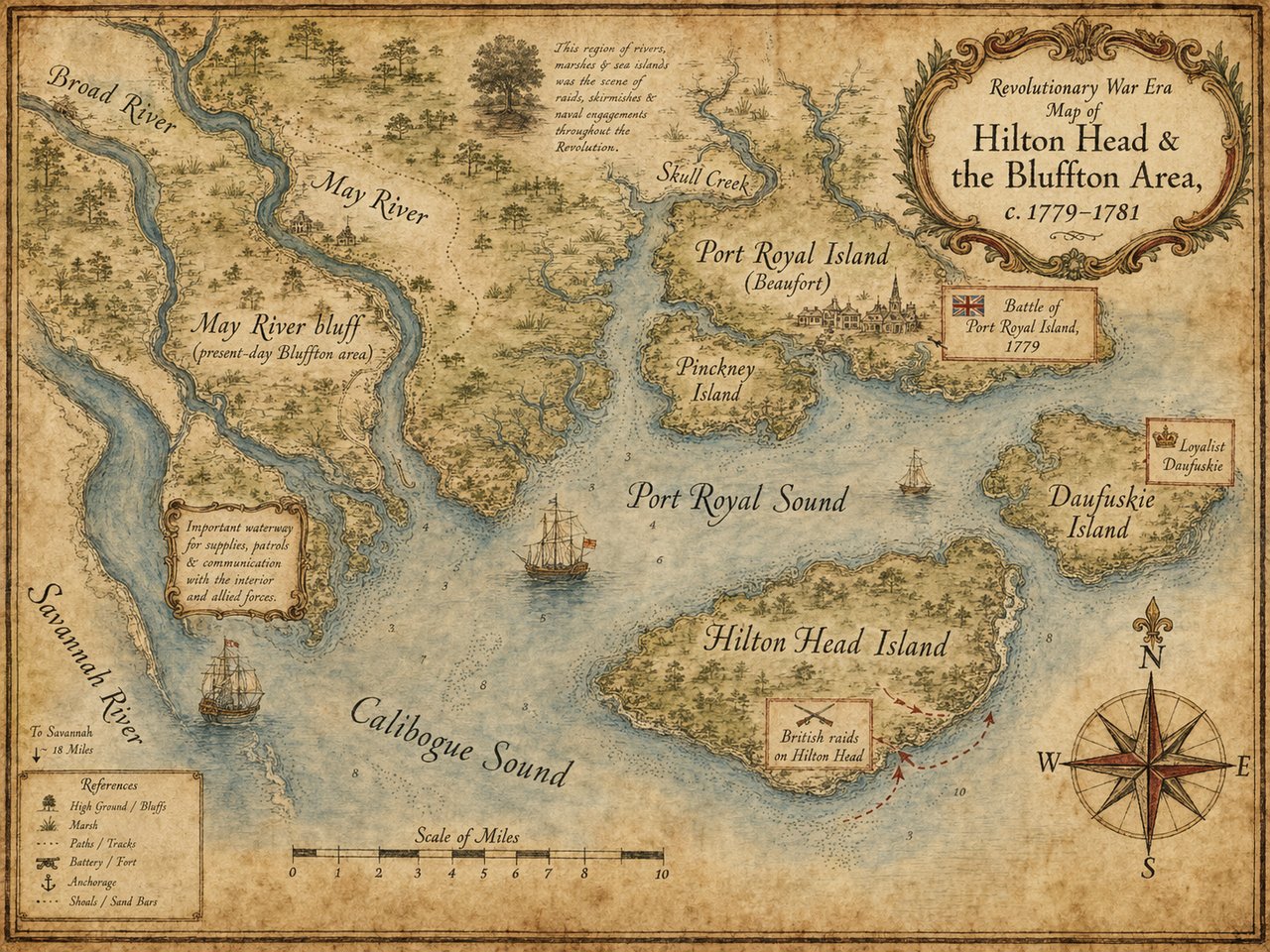
As we celebrate the 250th anniversary of American Independence, you may be wondering if Bluffton experienced Revolutionary War activity. While there were a number of battles and skirmishes throughout the Lowcountry, events specific to Bluffton are not well known. We do know that in May 1779, several houses in the Devil’s Elbow barony (modern-day Colleton River Plantation) were burned by British troops commanded by Major General Augustine Prevost. During this operation houses owned by John Colleton were torched and burned to the ground. John Colleton was the grandson of John Colleton who was one of the original Lords Proprietors in South Carolina. The only other widely known Revolutionary War action was the murder of British Loyalist Richard Pendarvis, AKA “Tory Dick,” that occurred on April 13, 1781, on Montpelier Plantation - in what we know today as Palmetto Bluff. That murder was in retribution for Tory Dick’s having been suspected of killing Colonial Captain James Doharty in December 1780 on Bear Island near modern-day Moss Creek Plantation. Aside from these three events, there was no other known Revolutionary War action that occurred in the Bluffton area. Or so we thought!
Who knew that cleaning a cemetery in Sheldon, SC, would lead to a new discovery of Bluffton area Revolutionary War activity and discovering a resulting legal battle that lasted over 70 years? Sheldon is an unincorporated area in northern Beaufort County near Pocotaligo. A gravestone in the cemetery reads:
Mrs. Margaret Euphemia Wigg (1809-1848)
Consort to William Hazzard Wigg
Born in in the City of Charleston, May 27th 1809
Died in the Village of Bluffton on May 18th, 1848
Seeing she died in the Village of Bluffton sparked an interest in me for additional research. I had studied old maps that showed the area on the northwest side of the Okatie River (now Oldfield Plantation) was once called “Wiggs Bluff,” so realizing this woman died in Bluffton made me think they could be related. My subsequent research revealed her husband was William Hazard Wigg II (1809-1875). As I delved further into the Wigg family history, I found his grandfather was also known as William Hazzard Wigg, and his story is definitely worth knowing.
The elder William Hazzard Wigg (1746–1798) turned out to be one of the most often overlooked figures of the American Revolution in the South Carolina Lowcountry. His life serves as a classic study of the "Southern Patriot" of that era. He was a man of great wealth and social standing who risked his wealth, his and his family's safety, and his personal liberty to support the cause for American independence.
Wigg was born on November 28, 1746, in Beaufort into the coastal elite of the Beaufort District. He was a member of a prominent family that had already established deep roots in the South Carolina Lowcountry. His father was Richard Wigg, who immigrated from Buckinghamshire England, possibly around 1705. By the 1770s, William Hazzard Wigg was a substantial planter, owning thousands of acres in the Beaufort and Bluffton areas and numerous enslaved people alongside the Reynolds, Fripp and Chaplin families. In the colonial era of South Carolina, men like Wigg were often the first to feel the pressures of British taxation and the tightening grip of the King against America. His land holdings included large tracts that likely included modern day Oldfield Plantation, the Camp St. Mary’s area where we believe his house was located, and parts of what today is Sun City Hilton Head.
When the Revolution broke out, Wigg did not hesitate to get fully involved. Unlike many of his contemporaries who chose to be loyal to the crown to protect their property, in 1775 Wigg committed himself to the local militia to secure freedom for America. He was commissioned initially as a Captain but then later as a Major in the South Carolina Militia, specifically within the Granville County Regiment (current Beaufort County).
Wigg fought in a number of Revolutionary War battles including the Florida Expedition in May-July 1778; the Battle of Coosawhatchie on May 3, 1779; the Battle of Charleston Neck May 11-13, 1779; the Battle of Stono Ferry on June 20, 1779; and the Siege of Savannah that occurred September-October 1779. He was a recognized hero in the Battle of Coosawhatchie, as he made a heroic effort to rescue a friend, John Cuthbert, who had been captured by the British. Wigg waited for the British army to appear, and as their prisoners were passing by, he rode into the line of fire to pick up Cuthbert and ride him to safety on his prized horse Independence. Wigg’s horse was named Independence because the steed was born on July 4, 1776, the same day the Declaration of Independence was signed.
From March 29 until May 12, 1780, Wigg was part of the defense during the Siege of Charleston. When the city fell to British General Sir Henry Clinton in May 1780, it was the greatest American defeat of the entire war. Wigg was captured along with over 5,000 other Patriot and militia troops.
Unlike the common soldiers who were often sent to disease-ridden prison ships in the harbor, Wigg, being an officer, was initially granted "parole." This allowed him to remain free although usually that required he remain in the Charleston area and not return to his home near Bluffton. It also required that he not engage in military efforts against the British war efforts. He was free to walk the streets of Charleston and interact with Charleston residents as an ordinary person. Wigg did this until he witnessed the British execute his brother-in-law Colonel Issac Hayne on August 4, 1781. Hayne had himself been captured by the British and paroled, but later the British ordered him to fight against the Patriot troops, and Hays refused to do so. As a result, he was held for treason against the Crown and without a trial was hung on the open streets of Charleston for all to see.
Wigg was enraged by the execution of his brother-in-law, and seizing a moment of high public emotion, he delivered an impassioned and defiant speech before a large crowd. In the speech he went so far as to say that the Colonial Army would find and execute a British soldier of the same rank in retribution for the execution of Hayne.
Wigg’s speech infuriated the British, and his parole was withdrawn. He was arrested and sent to the infamous prison ship Pack-Horse. The conditions on these ships were horrific; men died daily from smallpox, dysentery, and starvation. Wigg’s survival on these ships for nearly a year is a testament to his physical and mental fortitude. He was eventually exiled to St. Augustine, Florida, which was then a British stronghold serving as a dumping ground for the "most dangerous" South Carolina rebels.
Imprisonment was not the only punishment the British would impose against Wigg. While he was in captivity, the British, knowing Wigg was a high-profile Patriot leader, targeted his estates for total destruction. We don’t know the exact date, but British troops sailed into the Okatie River - passing many other fine homes of similar size - to burn Wigg’s home. Not only did they burn his home and outbuildings, they also looted his farm, stealing cattle, horses, and even 96 of his enslaved workers, who they would later sell. There are some reports the prison ship Pack-Horse also sailed into the Okatie River with Wigg aboard, so he could see his own house burn and compound the punishment. There are differing reports as to whether Wigg could see the fire itself or just the heavy column of smoke, but regardless, he would have known his large Southern home was being destroyed.
Following the war, Wigg faced the monumental task of rebuilding. He had lost nearly everything but his land. He became a significant figure in the early South Carolina state government, helping to draft the new laws for South Carolina and even served in the state legislature.
Also, after the war, Wigg filed a claim for “The Plunder of 1781,” seeking reimbursement from the British government for his losses. The British ignored Wigg’s claim, prompting him to file a different claim with the United States government for their failure to protect him under the terms of the Treaty of Paris (1783). He specifically cited Article VII of the treaty that said “the British would withdraw from the United States without causing any destruction or carry away any negros or other property owned by American inhabitants.” Some historical accounts also mention that the British government was required to return Wigg’s property after the war ended but did not do so. Despite his house being burned and his property confiscated prior to the signing of the Treaty of Paris, Wigg had evidence that the British had transported his enslaved persons to Florida and even to the British West Indies after the treaty was signed. Wigg also claimed the British burning of his home and property was “surgical,” and he was specifically targeted as evidenced by the fact that the British troops who carried out the raid had passed many other similar homes without any consequences to them, and that it was all done while Wigg was a prisoner of war.
Wigg’s claim remained active for over 70 years, well after his death. His son, William Hudson Wigg (1777-1827), continued the fight for justice, but he, too, died before closure was reached. Wigg’s grandson William Hazzard Wigg II (1809-1868) then continued to pursue the claim and in the early 1850s even moved his family to Washington so he could better lobby Congress for relief.
On August 11, 1852, the US Congress passed “an Act for the Relief of the Heirs of William Hazzard Wigg,” paying the Wigg family approximately $43,000, which would be worth millions in today’s dollars. By then the Wigg family included members of the Barnwell, Heyward, and Hazzard families. We are not certain how the money was divided, but there are records that suggest most of the money was invested in new land holdings and used to purchase enslaved people, all of which was lost during the Civil War due to the Direct Tax act of 1862 and emancipation, which resulted in devastating losses for many Southern landowners. Further reports indicate that by 1870 the Wigg family “fortune” was worthless.
It was very exciting to discover what was largely unknown local Revolutionary War history in the Bluffton area. And how ironic that Wigg’s and three generations of valiant efforts to recover the losses he sustained in service to his new country would, after 70 years, result in very little benefit and be a direct reflection of the fall of the Old South.
Author’s note: I encountered conflicting dates of deaths at times while researching for this article but have used dates taken from their tombstones.
- By Michael Reynolds- Lifelong Bluffton Historian.