The national real estate market has entered a new phase, one defined less by speed and momentum, and more by strategy, negotiation, and precision. While mortgage rates have eased slightly from recent highs, affordability challenges, rising inventory, and cautious buyer behavior continue to reshape how homes are bought and sold nationwide. The market no longer rewards assumption-based decision-making.
In many ways, today's housing market is no longer a "hot market" or a "cold market," it is a skill market. Success now depends on accurate pricing, strong positioning, market knowledge, and the ability to navigate buyer expectations in real time. These trends are especially evident in coastal markets like Hilton Head Island and Bluffton, where demand remains strong, but buyers have become increasingly selective and value-conscious.
Nationally:
Mortgage rates are still the #1 driver
Rates are hovering around 6.3% – 6.5% for a 30-year loan
They've dipped slightly from recent highs
Global factors (inflation, geopolitical tension) are keeping rates unstable
What this means:
Buyers are cautious, and affordability is still tight
There are fewer listings than normal
Inventory is rising, but not evenly
Active listings are increasing, and inventory is up year-over-year
New construction just hit a high in activity
BUT: Building permits are dropping, so the future supply may tighten again
What this means:
Short-term: more options for buyers
Mid-term: supply could tighten again if builders pull back
Sales are slow, even though prices are still high
Existing home sales are down, 3.6% month-over-month
What this means:
Sellers haven't fully adjusted expectations
Buyers are negotiating harder (this is where deals are happening)
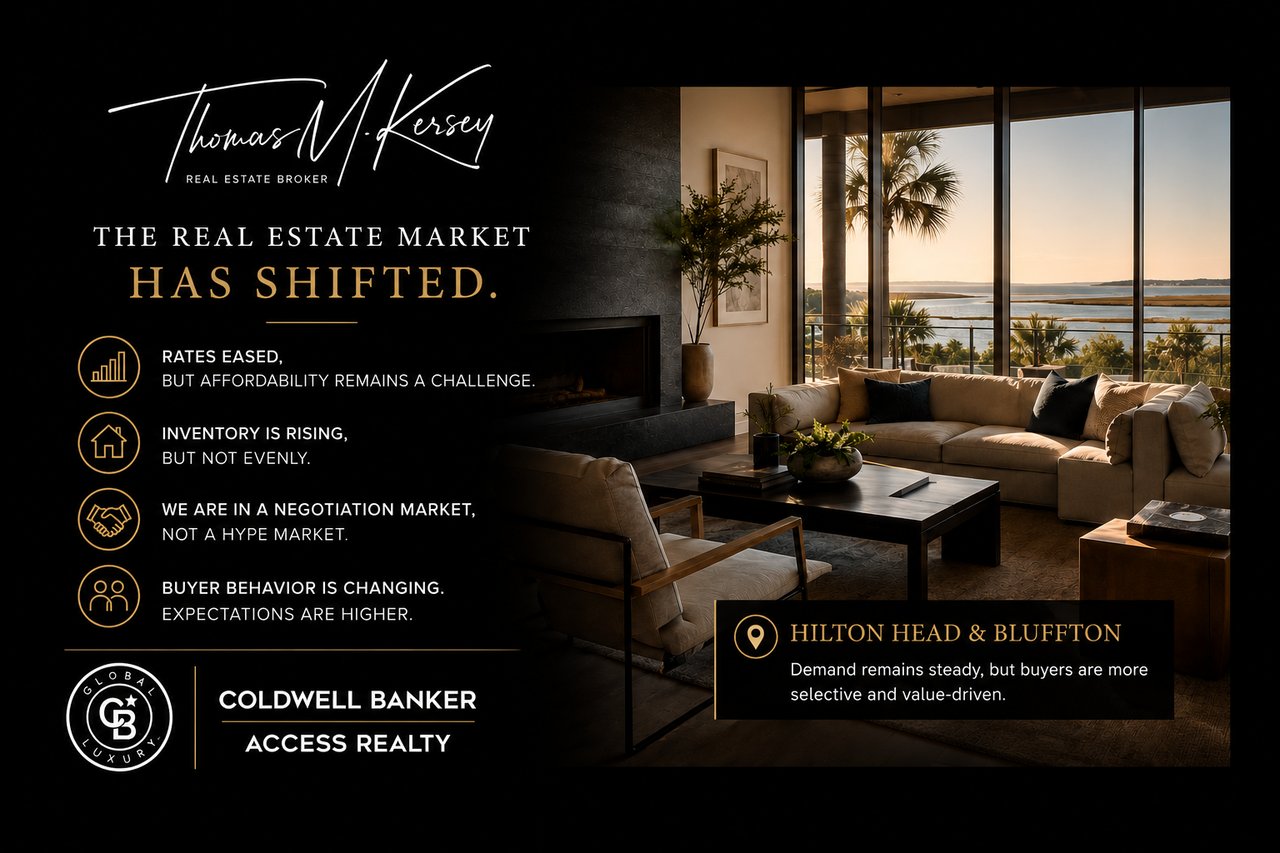
We are firmly in a "negotiation market."
Homes are sitting longer.
Inventory growth is creating a gap between seller expectations and buyer reality
What this means:
This is no longer a hype market; it's a skill market
Pricing strategy matters more than ever
Negotiation and positioning are critical
Regional shifts are getting more dramatic.
Sunbelt markets (Florida, Texas) are cooling or becoming buyer-heavy
Midwest/Northeast, relatively stronger demand
What this means:
Your Southeast exposure (Hilton Head / Bluffton) is still active, but more selective
Migration trends still matter, but buyers are more price-sensitive
Buyer behavior is changing.
First-time buyers are skipping "starter homes."
Many now want "forever homes" on first purchase.
What this means:
Higher expectations for the first purchase
Demand shifting toward
Multi-use homes
Income-producing potential
Long-term livability
Builders' vs. the resale market are two different stories
Builders are offering incentives to move inventory
Resale sellers are slower to adjust pricing
What this means:
New construction is becoming more competitive vs resale
Buyers are comparing deals more aggressively
Outlook: "slow recovery, not a rebound."
Forecasts for 2026 sales growth have been cut significantly
Market recovery is expected, but gradual and uneven
A Closer Look: Hilton Head and Bluffton
In coastal markets like Hilton Head Island and Bluffton, the shift is especially noticeable.
While demand remains steady, particularly from out-of-state buyers, the market's pace has changed. Properties are taking longer to sell, and buyers are approaching decisions with greater scrutiny. Pricing, condition, and overall positioning now play a more critical role than they did in previous years.
Sellers who enter the market with a data-driven pricing strategy and a clear understanding of current buyer expectations are still achieving strong outcomes. However, those relying on past market performance are often experiencing extended days on market and incremental price reductions.
At the same time, new construction continues to introduce competition, with builders offering incentives that are influencing buyer decisions across the region.
This is a market that rewards precision and punishes assumptions.